


King’s Cross is one of the more diverse parts of the West End office market, offering a wide range of office spaces supported by strong transport links, locally, nationally, and internationally. Investment and regeneration of this part of London have enabled the growth of a business community spanning from start-ups to global firms.
The core of the office market is King’s Cross Central, the transformation of a once-derelict railway and industrial area into one of London’s most ambitious mixed-use districts, bringing together premium offices, retail, cultural institutions and new public realm across 67 acres. Home to some well-known brands, it has become a benchmark for modern, amenity-rich urban regeneration. The new kid on the block is soon to be opened Google’s UK headquarters at the KGX1 dubbed “groundscraper” building.
King’s Cross lies at the heart of what is known as the Knowledge Quarter, with its connections to the rest of London and leading university cities such as Cambridge and Oxford having contributed to the growth of the area, home to a range of major tech, research, education and life sciences firms clustered around world-class centres such as the Francis Crick Institute and the Alan Turing Institute.
Despite these strengths, leasing volumes have been far lower post-pandemic. The Devono Insights team has reviewed the data to understand how supply, demand and occupier behaviour have reshaped this submarket.
LIMITED ROOM AT THE TOP
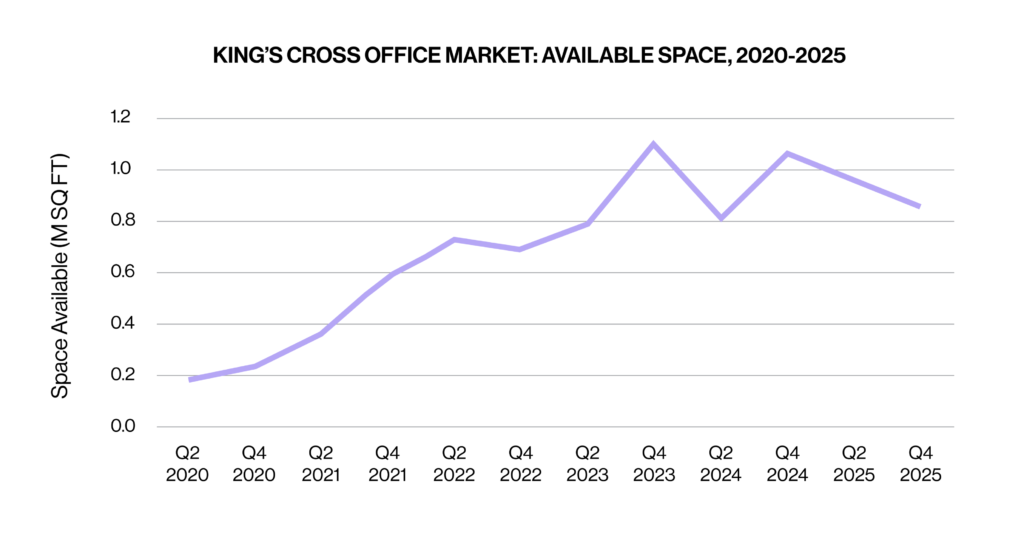
On the face of it, King’s Cross offers a sizeable quantity of available space compared with other West End submarkets, recording the third largest total after North of Oxford Street and Victoria. While availability has trended downwards over 2025, levels rose sharply after the pandemic that the current available stock remains more than quantity of space available is still more than four times above that recorded in Q4 2020. Grade A availability tells a similar story: despite a 45% drop since the end of 2024, supply is still three times higher than five years ago.
Yet this masks a critical constraint. Large units are scarce. At the time of writing, only four spaces could meet requirements above 50,000 sq ft, falling to two for Grade A. Although we are seeing some new additions to the stock such as 1 Triton Square complete, the pace of pre-letting on the 2026 pipeline is already clear, with the Assembly and Connector buildings both under offer.
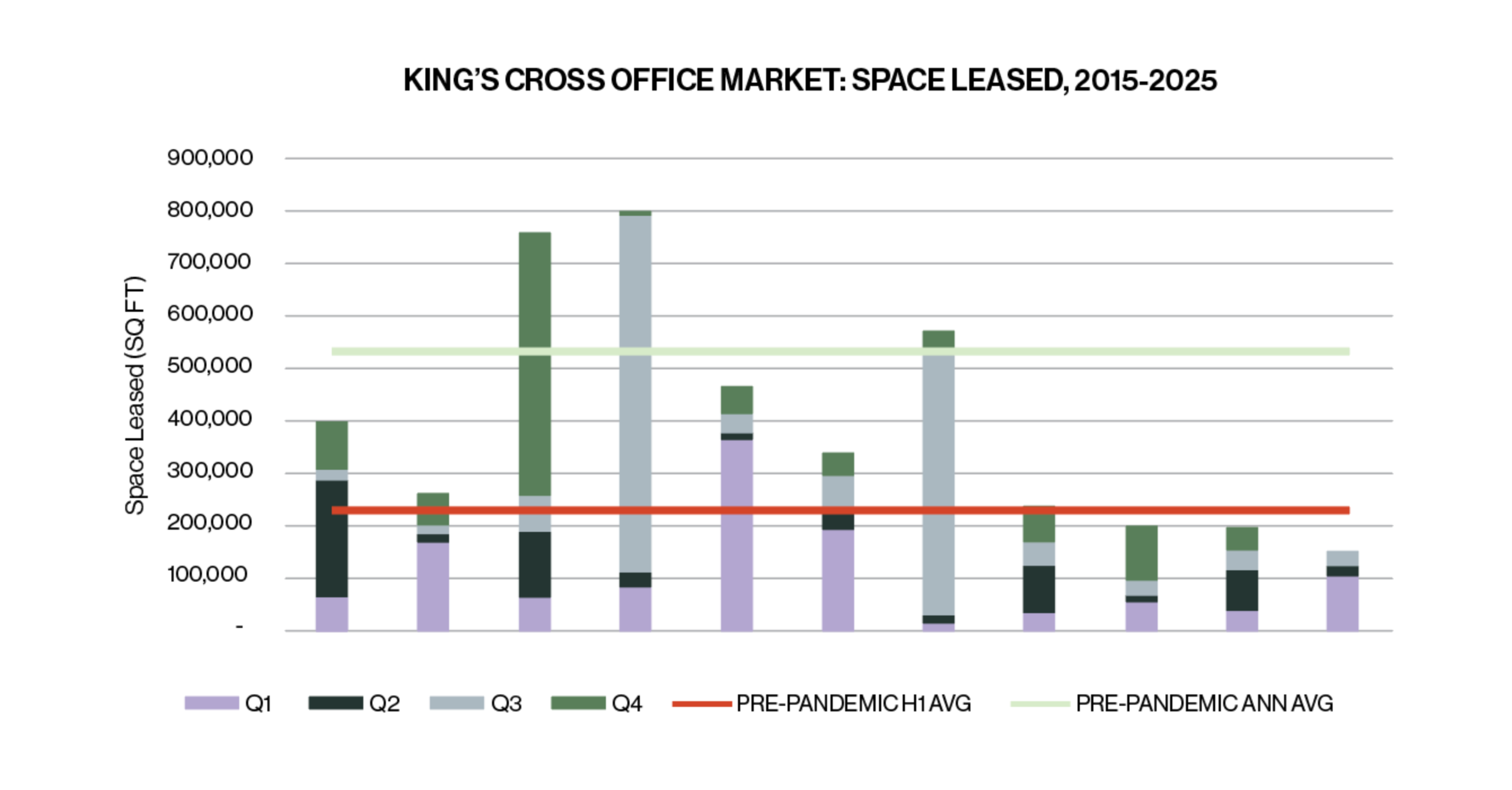
This shortage has reshaped post-pandemic activity. Historically, quarterly volumes have fluctuated sharply, driven by sporadic mega-deals such as those seen in Q3 2021. With no transactions on that scale since then, annual take-up has plummeted. Full-year totals in 2023 and 2024 were both below the short-term pre-pandemic half yearly (H1) average. The trend has strengthened in 2025: with no deals above 25,000 sq ft, volumes for Q1 to Q3 are 39% below the short-term average. The market is now reliant entirely on small and mid-sized transactions.
PREMIUM PRICING, NARROWER OPTIONS
Rental dynamics have also worked against the larger end of the market. Grade A space in the core of King’s Cross is currently priced at the upper end, at £110 per sq ft. For cost-conscious occupiers who feel priced out of this market, comparatively they could secure Grade A options in Victoria or high-quality secondhand space north of Oxford Street, while gaining access to a much wider pool of larger floorplates. The City also remains a more cost-effective alternative, with prime rents still 9% lower than King’s Cross.
The impact of higher rents and fewer options is visible in Grade A deal sizes. Before the pandemic, firms choosing Grade A space in King’s Cross were averaging a space size of 70,262 sq ft, whereas post-pandemic the average fell to 39,184 sq ft, now down at 11,261 sq ft as of 2025. Importantly, this drop has occurred despite both periods recording the same average number of transactions per year. The difference lies in the absence of large deals: firms that need substantial space either cannot find it or cannot justify the cost.
A MARKET SHAPED BY ITS OCCUPIERS
The shift in volumes also reflects the profile of the occupiers who favour King’s Cross and their typical size requirements. Tech remains the dominant sector, accounting for 38% of 2025 deals and 37% of space leased. Prestige, proximity to peers such as Google and Meta, alongside knowledge-sharing opportunities continue to draw firms to the area. The same goes for the healthcare providers who have been attracted to King’s Cross’s biomedical research hub, with this sector having been the second most active for space leased in 2025, mainly due to the NHS’ acquisition of the new-build 1 Granary Street.
Yet the deals generated by these sectors tend to be modest in scale. Across central London, tech leases average 7,113 sq ft and healthcare 8,698 sq ft. By contrast, the financial sector, which leads London in volume leased, accounted for only 8% of King’s Cross deals in 2025. The legal sector, which averages 21,536 sq ft per deal, has not taken any space in King’s Cross this year. These sectors remain anchored to their established clusters elsewhere.
As a result, the specificity of King’s Cross’s appeal is now defining its leasing performance. Volumes fluctuate in line with the needs of its core innovation-driven occupier base, rather than the broader market.
WHAT DOES THIS MEAN FOR THE OCCUPIER?
At first glance, lower leasing volumes might suggest diminishing demand, our analysis shows a more nuanced picture. Occupiers are not turning away from King’s Cross. Instead, availability, pricing and sector mix have collectively repositioned the submarket. King’s Cross has evolved into a location suited to small and mid-sized firms within knowledge sector fields such as tech, education, and healthcare.
For organisations considering a move to King’s Cross, the key question is what they want their office to achieve. If the priority is a large, cost-efficient space to support regular occupancy, King’s Cross is unlikely to meet that need. However, for occupiers seeking to embed themselves within a highly connected ecosystem of innovators, researchers and global brands, the value of King’s Cross remains as compelling as ever.



