


MEDIA’S FOOTPRINT SHRINKS AS LEASING LAGS
Central London has long served as a hub for media firms, with many areas of the capital having become famous for their association with the sector, whether it be Fleet Street for the publishing sector or Wardour Street for film and post-production firms. The sector’s presence in central London encompasses a wide spectrum of firms from the largest corporates, the majority of which hold a large footprint including the likes of the BBC, Sky and RELX, through to the smallest boutiques agencies.
However, despite the media sector’s heritage and existing footprint, the sector is not contributing as significant a share of leasing activity as had previously been the case. Media firms accounted for only 6% of the space leased in central London in 2024, a share that has remained consistent since 2021. This contrasts with leasing activity pre-pandemic (2015-2019), when the average media sector share of space leased equated to 11%. The average annual total for space leased post-pandemic (2020-2024) has been significantly lower than that recorded pre-pandemic, down 46%.
A major reason for this has been the absence of the 100,000 sq ft+ deals being signed since 2020, as larger firms have been rationalising their requirements with Bauer Media and Condé Nast both having taken spaces below this size. Many of the small-to-mid-sized firms have also followed suit, with the average deal size post-2020 being 5,407 sq ft, 37% smaller than the average recorded across the pre-pandemic period.
SOHO SHINES, CITY SURGES AHEAD
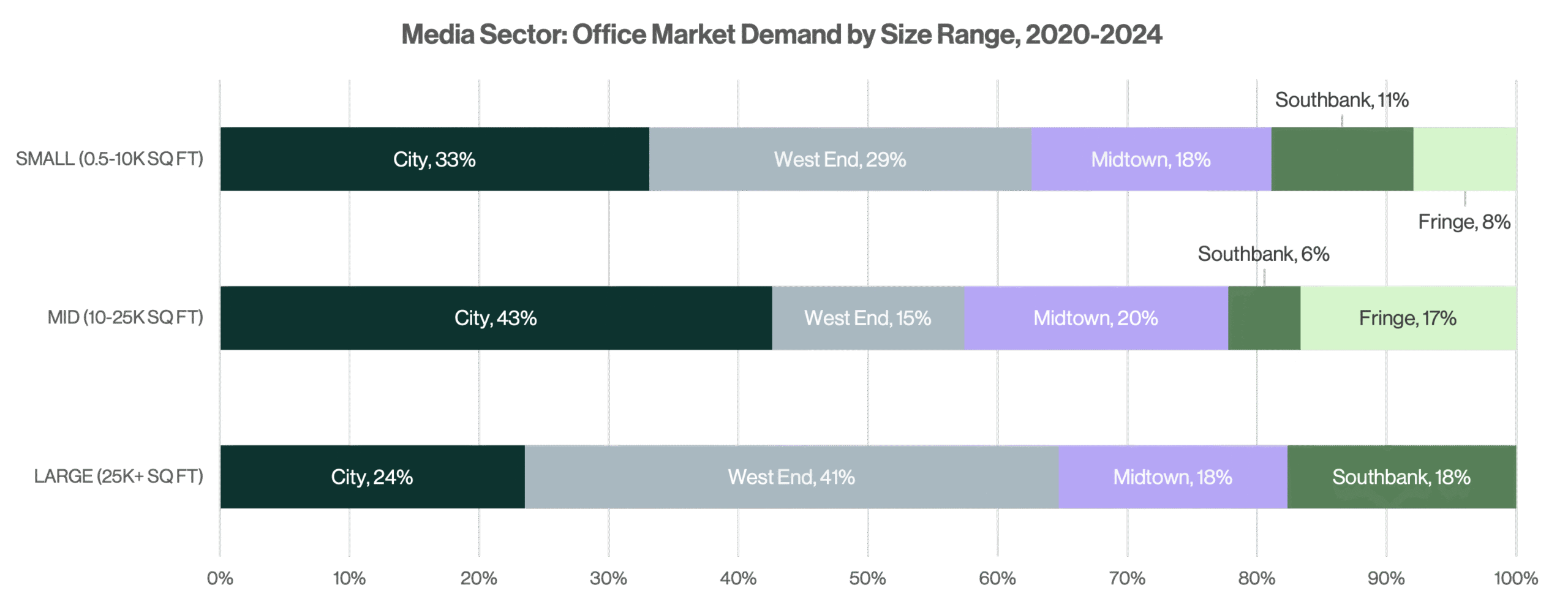
While the last five years has brought with it a shift in tenant requirements, media firms have largely remained loyal to the same locations. Despite a greater association with submarkets in the West End like Soho, media firms were already migrating to the City market pre-2020, with this market having accounted for 31% of the deals transacted as compared to 26% in the West End. This trend has not only continued but intensified since the pandemic, with the City’s share of deals growing to 34%.
This is not to say that media occupiers are avoiding their traditional West End hotspots; this market’s share of deals has also grown to 28% post-pandemic from 26% with the Soho and North of Oxford Street submarkets in particular continuing to attract the lion’s share of West End media sector demand.
So why are we seeing the City continue to account for more transactions than the West End?
FROM STUDIOS TO STORIES: LEASING TRENDS
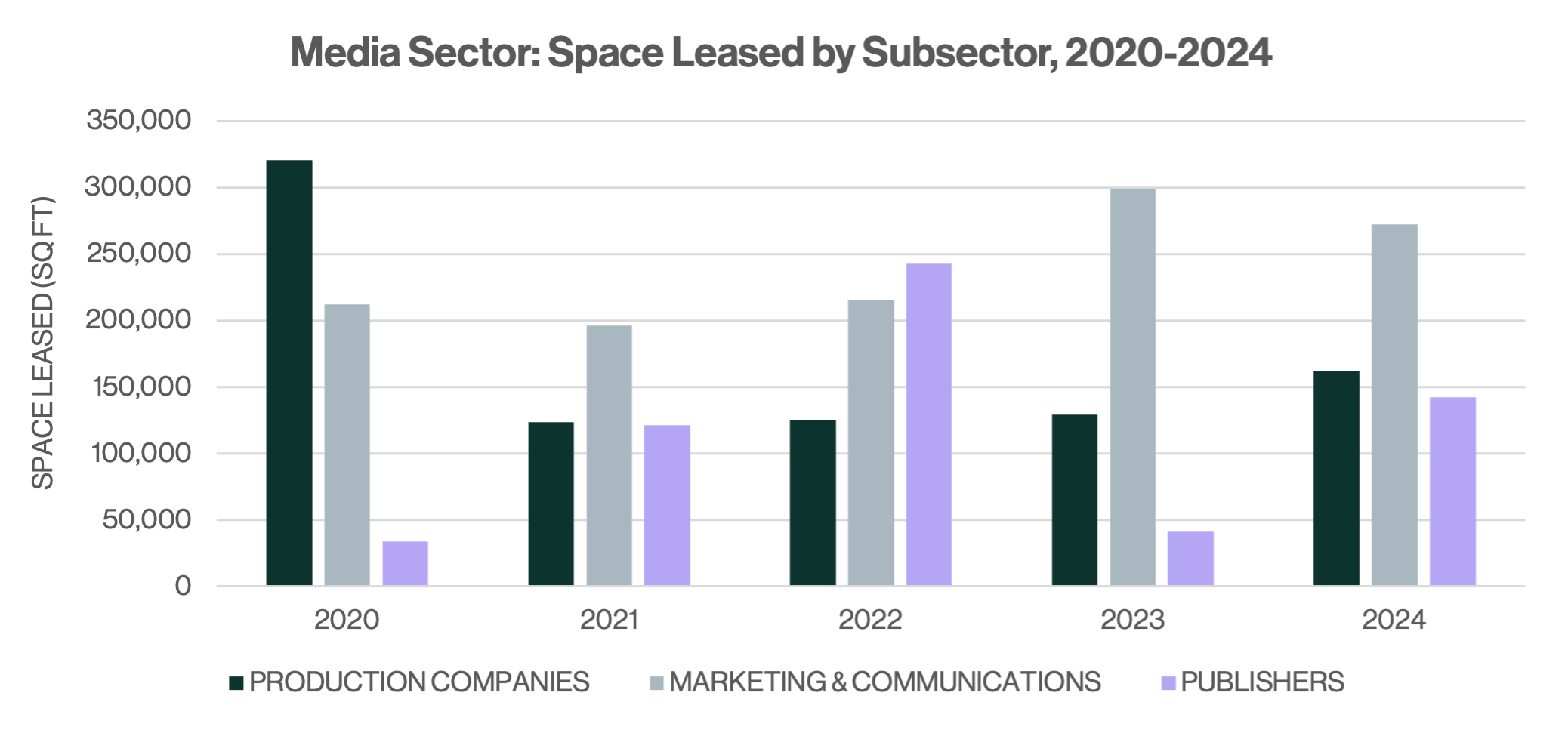
Looking at subsectors of the media sector, we shine a light on leasing activity by production companies involved in the film and music industries, publishers of printed and online media, and the marketing and communications subsector, which broadly includes marketing agencies, public relations firms and branding consultancies.
Lights, Camera, Smaller Office Footprints
The production industry has fallen victim to external shocks in recent years. Following an enforced shutdown of film sets, leasing by production houses fell by 61% from 2020-2021, and while levels have been increasing year-on-year, space leased in 2024 remains 49% below the 2020 peak. The reduction in space leased has mainly come from a reduction in large requirements, with no deals recorded over 50,000 sq ft in 2021-24. Nevertheless, deal numbers have remained strong at an average of 36 a year since 2021. At the same time, the average deal size has reduced, now less than half of that recorded in 2020 at 4,380 sq ft. This is in part a result of hybrid working patterns, cost-cutting drives and a decline in advertising revenues impacting workplace and workforce strategies.
Marketing Momentum Meets Market Headwinds
Leasing activity by marketing and communications firms has fared better. While still below the high recorded in 2019, the 272,000 sq ft leased by the sector in 2024 represents an increase on the five-year annual average of 8%. This has primarily been due to the larger deals returning, with VCCP taking 58,000 sq ft of office space in 2024 at 66-68 Berners Street. However, as quickly as they reappeared, no deals of this size have been signed in 2025 as marketing and communications agencies continue to grapple with wider economic uncertainties, and additional costs related to changes with data protection and privacy laws and the growing need to invest in AI.
Publishing Peaks, Then Levels Out
Leasing by the publishing sector has fluctuated since the pandemic. Following a low at the onset of the pandemic, space leased by publishers increased in 2021 followed by a peak in 2022 of 243,000 sq ft. However, in the last couple of years leasing by publishers has not met the same level, with the 2024 total sitting at approximately half that recorded in 2022 amidst larger publishers rationalising their space requirements, including major player Elsevier who took only 21,000 sq ft for their London branch at the MODE development, 125 London Wall. Deal numbers remained high in 2024 with 22 deals transacted, the highest recorded since 2021. This year publishers face numerous challenges including competition from AI-generated content and the evolving landscape of intellectual property laws.
CENTRAL LONDON’S CREATIVE CORE PERSISTS
Although at the end of 2024 media take-up seemed to be picking up, with a post-pandemic quarterly high recorded in Q4, the first quarter of 2025 has seen leasing volumes fall once again with no deals recorded over 14,000 sq ft. That being said, deal numbers have remained above the short-term quarterly average.
So, while it remains the case that we are not seeing the larger firms shifting the leasing landscape in the same way as was the case pre-pandemic, the small-to-mid-sized studios remain not just keenly committed to the office but remain a core part of the fabric of central London.
Mark James, Research Analyst at Devono: “While the media sector may not be a source of market-moving office transactions, the sector remains a vibrant part of the central London office market. Despite there being little respite for the sector as covid-era obstacles are replaced with challenges around emerging technologies, persistent deal numbers indicate that media firms remain committed to the office nonetheless”.
If you would like any further information on this insights, please do get in touch or alternatively you can find more on our website at www.devono.com



